

In This Bust-To-Boom Story, Blue Frontier’s Plucky Founder Explains Why It Is Cool To Be Blue
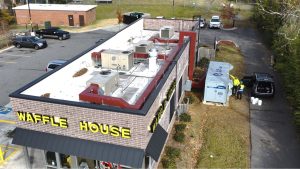
Blue Frontier’s first IN2 pilot project took place at Waffle House in Macon, Georgia, where the air conditioning system (large grey box in the grass next to the building) helped cut operating costs and improved air circulation in the hot back-of-the-house kitchen. Photo from Blue Frontier
In July 2025, a team of technicians walked into a Waffle House in Macon, Georgia. That month, peak temperatures sizzled at about 92 degrees Fahrenheit. In the restaurant’s kitchen, where cooks fried patty melts, hash browns, and waffles on an oil-slick grill, temperatures could feel just as hot, if not hotter.
The cooks kept sizzling while the technicians installed a machine out back and turned it on. Within minutes, the cooks came out. “What did you do?” they asked. “This is the first time we’re not sweating in the middle of summer.”
“At that moment, we realized that we were on to something,” said Daniel Betts, the CEO and founder of the start-up Blue Frontier.
Blue Frontier—along with researchers at the National Laboratory of the Rockies (NLR)—has created a new kind of air conditioner that can run on far less electricity. It also cools and dehumidifies independently, which makes it quicker and less energy-intensive to convert hot, sticky air into comfortable cool. Their system can even store energy, so it can power itself during the hottest summer afternoons—even sweaty July days in Georgia—to both avoid high energy prices and help prevent grid overloads and blackouts.
“We talk a lot about machines and energy,” Betts said. “But society is made of people. And we are influencing that directly, you know, making people’s lives better.”
That Macon Waffle House was the company’s first real-world pilot, a project made possible with support from the laboratory’s Innovation Incubator (IN2) program. The pilot was successful, both physically for those hot cooks and statistically: The system consumed 40% less energy than the building’s previous air conditioner and cut operating costs by 65%, in part due to an 89% reduction in power use during peak grid hours when electricity costs are highest.
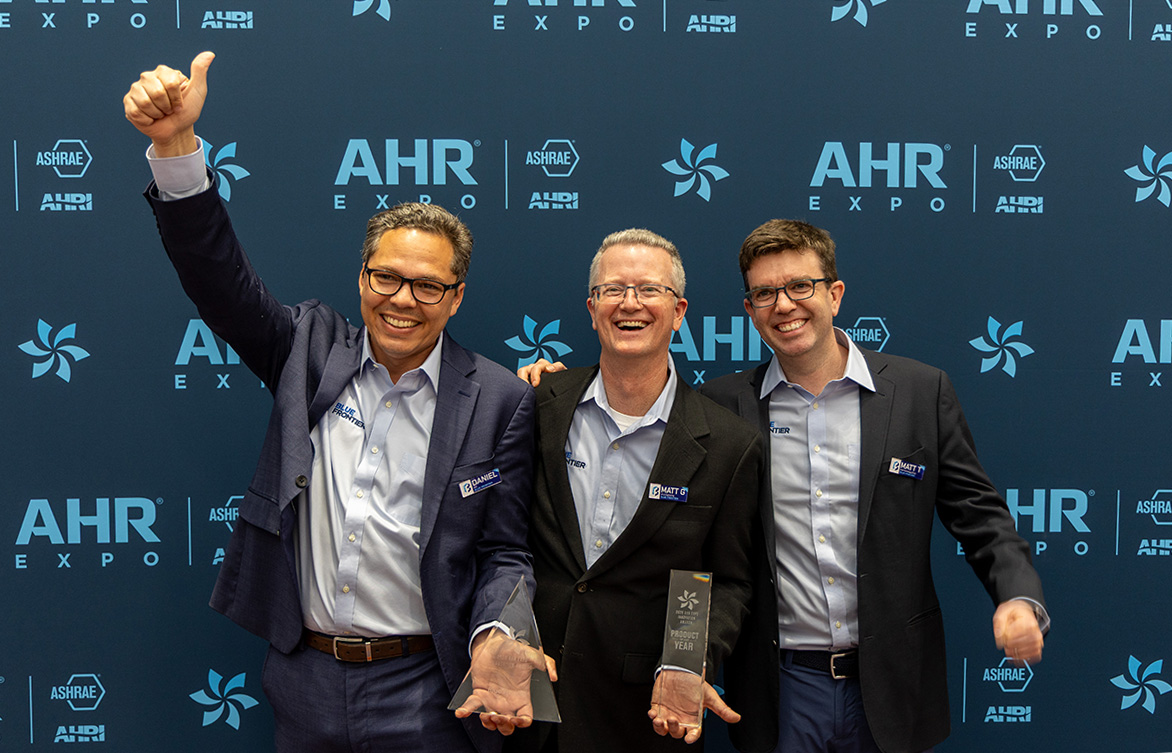
Those cool numbers earned the technology some high-profile recognition, including an R&D 100 Award, Federal Laboratory Consortium’s Excellence in Technology Transfer Award, and Product of the Year from the International Air-Conditioning, Heating, Refrigerating Exposition (essentially the Oscars for heating and cooling engineers).
But Blue Frontier’s horizon was not always so peachy. It took more than a decade—plus an initial bankruptcy—for Betts and the team to make it this far. And, according to Betts, they are at “one of the most difficult points for a company.”
“It’s a new world that we’re under, and it carries risk, but it also carries the reward of seeing your company grow and actually make real customers happy,” Betts said, “which is the entire purpose of the company.”
Daniel Betts, Matt Graham, and Matt Tilghman (left to right) founded their start-up, Blue Frontier, in a hot Floridian garage. The only conditioner was the prototype they hoped would one day cool buildings using a fraction of the energy of conventional machines. Photo from Blue Frontier
Kink in the Grid
Betts’ parents are both doctors. So, apple and tree, he planned to be one, too.
In high school, he fought for an internship at the National Institutes of Health (NIH)—and got it. After school, he went to a lab to study how cells react to allergens; he did so well that an NIH lab in Brazil recruited him to study Giardia parasite cells. When he got into George Washington University, Betts initially planned to continue his cell-driven path and go pre-med, but he realized something: It was not the cells that kept him coming back to the lab. It was the machines he used to study them.
“It was the physics not the biology that drove me,” Betts said.
So, Betts decided to become an engineer. And, like cells in biology, he realized energy was the machine behind the machine.
“It’s super necessary for everything that we are. It’s civilizationally critical,” he said.
Betts specialized in fuel cells and hydrogen and earned a Master of Business Administration and a Ph.D. (both from the University of Florida). During that doctoral research program, he helped the national utility in Panama (his first home) optimize their hydroelectric energy production. Then, after graduating, he joined the start-up EnerFuel Inc., which built fuel cells and batteries.
But through all these energy-related efforts, one type of machine kept reappearing: air conditioners. Every time he tried to fix an energy problem—whether it was hydropower, fuel cells, or batteries—these cooling machines always seemed to be the snag.
Air-conditioning can be like a tsunami: A trigger, like spiking afternoon heat, creates a wave of energy demand that can overwhelm power grids. It is temporary but maddening. A grid can only support the demand of its highest peak, and air-conditioning is that peak more often than not.
When Betts visited NLR to give a talk, air-conditioning came up yet again. “If there was a way to add efficiency and energy storage into the air-conditioning load,” Betts told the crowd, then both energy and costs would plummet. Later that day, in a lab across campus, he met two NLR researchers who created something that could potentially do exactly that.
“Wow,” Betts remembers thinking, “here are the wizards that have figured out the solution to the entire thing.”
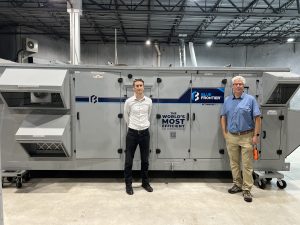
Jason Woods (left) and Eric Kozubal coinvented the technology behind Blue Frontier’s supercool air conditioner. Photo from Blue Frontier
A Salty Solution
Those “wizards” were Eric Kozubal and Jason Woods, two senior engineers at NLR who coinvented a technology called the Energy Storing and Efficient Air Conditioner (or ESEAC).
“It’s a complete rethinking of how we condition air—and when we use electricity to do it,” Kozubal said in an article on the ESEAC.
More than half of the energy consumed by air conditioners goes to dehumidifying air. Conventional systems often overcool a room just to achieve a comfortable humidity level and must then heat it back up to the desired temperature.
But Blue Frontier and NLR’s system uses a salt-based liquid to pull moisture from the air—just like table salt absorbs water, infamously clumping on humid days. The heat from that now-dry air is then pulled into an adjoining heat exchanger, a device that can move heat energy from one medium to another. There, the air is chilled using evaporative cooling. Just like sweat evaporating from skin helps cool our bodies, evaporating water reduces the air’s temperature to a comfortable level. When the salt solution becomes too diluted to absorb any more water vapor, the system uses heat to evaporate some of the water and reconcentrate the salty liquid.
This salt-and-water system needs little electricity—just enough to power a fan and small pumps—and also consumes less energy as temperatures rise.
The technology was young, but Betts was “mesmerized by the potential,” he said. A couple years later, he licensed it to create an air conditioner that ran on the heat from a fuel cell. He launched his first start-up, Be Power Tech Inc. Four years later, he shut it down.
“That’s a really good idea. I stand by it,” Betts said. “But it requires two new technologies to play together, fuel cells and the NLR air-conditioning tech.”
Double new can mean double the risk, and risk can make investors nervous.
“It broke my heart, but a good entrepreneur is a glutton for pain,” Betts said. “And I’m driven by the potential for innovation and the responsibility associated with knowledge and capabilities that we carry, right? We’re here to leave the world a little bit better.”
The wizards would agree.
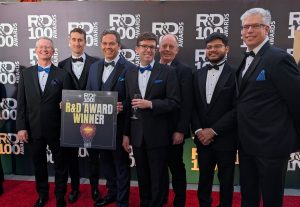
After the Blue Frontier team pivoted from a fuel cell/air conditioner combo back to a conventional air-conditioning system, their technology took off, eventually winning them (and the original NLR inventors) a prestigious R&D 100 Award. Photo from Blue Frontier
Army Bases, Movie Theaters, and a Thousand Sales Engineers
Betts went back to Kozubal and Woods at NLR. Together, they found a way to turn the original invention into an air conditioner that could power up when power is cheapest (or most convenient).
Betts licensed the technology again, and Blue Frontier was born.
Thanks to an add-on invention created by NLR experts, something called an Electrically Driven Desiccant Regenerator, the new system could ditch the need for heat generated by a fuel cell and, instead, use the hot side of the refrigeration cycle to reconcentrate the technology’s core salt solution. That reconcentration can happen at any time, enabling companies to recharge at night or during other periods of low electricity demand when prices are low.
“That new invention transformed the air conditioner into one that consumes 90% less electricity at peak, and 50% less year-round,” Kozubal said. “It can be recharged like a battery, consuming electricity when it’s cheap.”
The journey from new invention to market success still had bumps.
“But this is again where NLR has been extraordinary,” Betts said. “We found out how to jujitsu the physics into doing the things that we wanted to do.”
NLR’s experts and their “engineering rigor,” as Betts said, helped confirm the idea could work. The laboratory’s backing boosted investor confidence.
And the grants rolled in.
Just like in all good start-up fairy tales, the Blue Frontier founders tinkered with their prototype in a two-car garage in Florida (ironically, not air-conditioned). They sacrificed salaries, fancy dinners, and vacations. But, unlike in the fairy tales, the team got to test and improve their design in NLR’s facilities, too. Those tests gave them the confidence to turn their design into a product.
The leap to product is exciting, but it comes with new questions, like: How much would it cost to manufacture this? Can we turn a profit?
“If you don’t have that, you’re not a real business,” Betts said. “And the IN2 program allowed us to define that and raise capital.”
Investors backed Blue Frontier, which gave the company enough of a backbone to build. Now, they have installed their air conditioners in a U.S. Army base in Georgia and an Air Reserve Base in Massachusetts, an IMAX theater at the Museum of Discovery and Science in Florida, plus educational campuses, healthcare centers, restaurants, and grocery stores. As of 2025, they have a network of more than 1,000 sales engineers operating across the United States.
“Blue Frontier’s success is a win for the company, our laboratory, and partnerships between industry and our national laboratories,” said Achilles Karagiozis, the Building and Industrial Energy Innovation Center director at NLR. “But, more importantly, it’s a win to give Americans a way to reduce their energy costs without having to compromise on comfort.”
Bootstrapping and Belief
Blue Frontier still faces risks and challenges ahead. Today’s customers not only expect successful pilots; they expect perfection. Scaling up requires more people, partnerships, manufacturing, and distribution. And that means more investors and more money.
“That bootstrapping requires a lot of sacrifice from the team, and we all have to believe that what we’re doing is the right thing,” Betts said.
Lucky for them, their customers—like those Waffle House cooks who finally felt relief from the heat—seem to believe that, too.
Comments are closed.